Skip to content
Discharge-day delivery: (825) 445-5851

Electric Hospital Beds & Pressure Care

Alternating Pressure Mattress Rental in Calgary

An alternating pressure mattress is a row of air cells connected to a pump. On a repeating cycle, roughly 8 to 25 minutes depending on the model, the pump deflates some cells and inflates others, so the parts of the body carrying weight keep changing. For someone who cannot shift position easily, it means the tailbone, hips and heels are not resting on the same spot hour after hour.

We rent alternating pressure systems in Calgary from Drive Medical and SPAN, the Span-America line now sold by Savaria, matched to the person’s weight, the bed and the care team’s instructions. Each system is fitted to the bed, inflated and checked, and the caregiver is shown the alarms, the firm setting for care and what the system does if the power goes out.

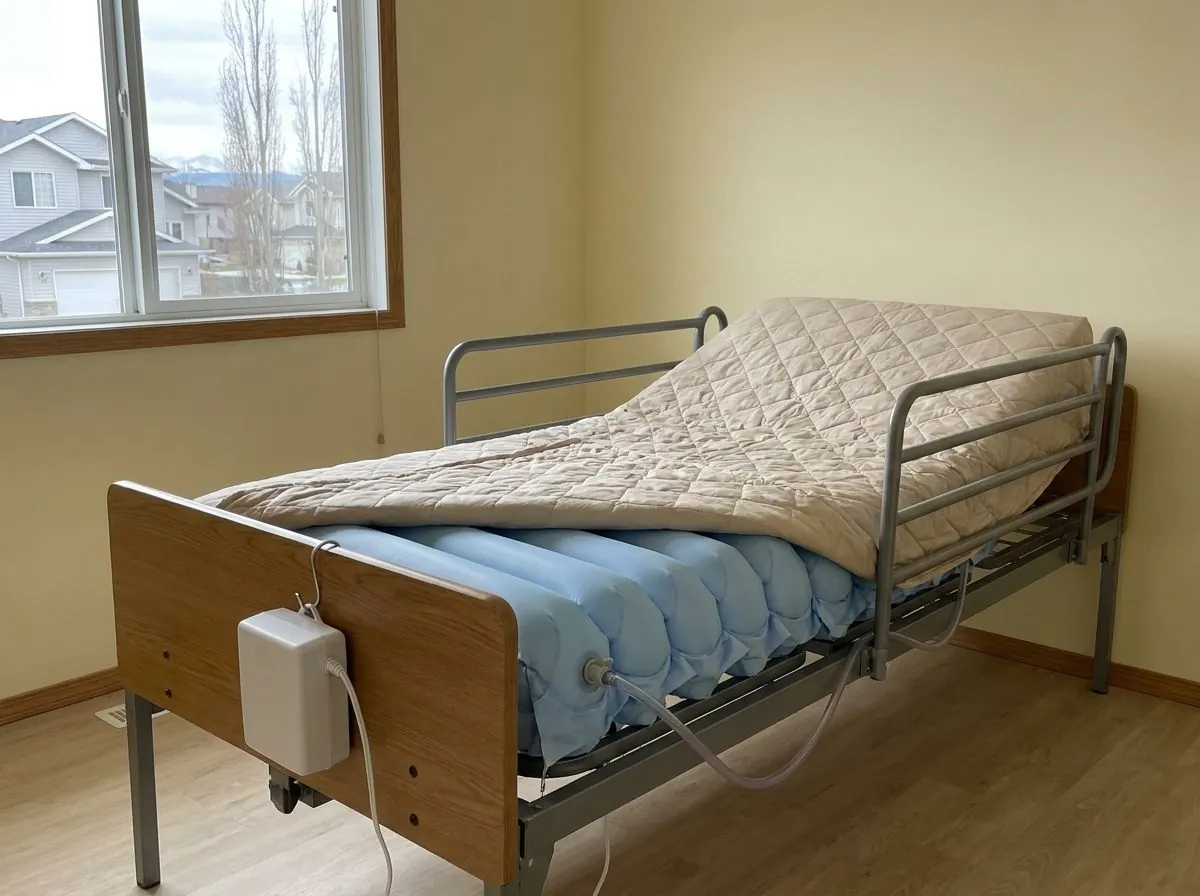
A hospital bed with its fitted cover folded back to show a row of blue air cells running across the mattress, with a small pump unit hooked over the footboard.
Air cells under the cover inflate and deflate in turn

Monthly rental

$220–$320/mo

Models we rent

  • Drive Medical Med-Aire Plus (14029)
  • Drive Medical Med-Aire Essential (14508)
  • SPAN (Span-America) PressureGuard
  • Delivered and set up in your home
  • Cleaned and safety-checked before every rental
  • Itemized receipts for benefits claims

Who this rental is for, and when it is needed

Families usually arrange one because a nurse or wound care clinician has asked for it. Someone leaving Foothills Medical Centre after weeks in bed may already have a reddened or open area of skin, and the home care plan says they need a pressure-redistributing surface from the first night home. Others rent ahead of trouble, for a person who can no longer turn themselves or who now spends most of the day lying down.

These systems are common in palliative care at home, where turning someone every few hours becomes uncomfortable for them and exhausting for the family. They also come up after a stroke, a spinal injury or a long intensive care stay, and for people at either end of the weight range, where the right surface depends on the rating. Discharge notes from Peter Lougheed Centre, Rockyview General Hospital or South Health Campus may describe the surface in different ways: “air mattress”, “APM”, “low air loss”. Read us the exact wording and we will match it.

The choice of surface belongs to the nurse or clinician. We supply the model that fits their plan, make sure it works on your bed, and teach the family to run it.

Situations we set this up for

  • A pressure injury noted in hospital that continues at home
  • Unable to change position without help
  • Spending most of the day and night in bed
  • Palliative care, where frequent turning is hard on everyone
  • A discharge plan naming alternating pressure or low air loss
  • A heavier person who needs a higher-rated surface
  • Heat and moisture building up on a standard mattress

Models and specifications

Figures below are the manufacturer's published specifications. We confirm the exact unit and its ratings with you before delivery.

Drive Medical

Med-Aire Plus 8" Alternating Pressure and Low Air Loss Mattress System Model 14029

The Med-Aire Plus is Drive’s combination system: alternating pressure and low air loss in one 8-inch mattress. It is the only system on this page with a selectable cycle, offering 10, 15, 20 or 25 minutes, so the clinician can set the rhythm rather than accept a fixed one. The compressor delivers 8 litres of air per minute, and comfort weight settings let the surface be tuned to the person.

Its 20 air cells use a cell-on-cell design with a pillow feature at the head, and individual cells detach with quick disconnects if one needs replacing. Drive says the design prevents “bottoming out” on the bed frame and gives up to 24 hours of power-outage protection. Three audio and visual alarms cover air pressure, system faults and power loss; Auto-Firm, Seat Inflate and a lock-out complete the controls.

The removable cover is four-way stretch polyurethane: fluid-resistant, low-shear and vapour-permeable. A CPR valve deflates the mattress rapidly in an emergency. Drive rates the system at 450 lb and describes it as designed for the prevention and treatment of pressure ulcers in home and long-term care settings. An 84-inch version (14029-84) exists for longer beds.

Therapy
Alternating pressure + low air loss
Cycle time
Selectable: 10, 15, 20 or 25 minutes
Air cells
20, 8" deep, cell-on-cell, removable
Airflow
8 L/min
Alarms
Air pressure, system, power (audio and visual)
Modes
Auto-Firm, Seat Inflate, lock-out
Weight capacity
450 lb
Emergency
CPR valve for rapid deflation

Drive Medical

Med-Aire Essential 8" Alternating Pressure & Low Air Loss Mattress System Model 14508

The Med-Aire Essential is Drive’s simpler alternating pressure and low air loss system. Its pump runs one fixed 10-minute cycle, so there is no cycle setting to get wrong, and a pressure knob is scaled by patient weight up to 350 lb. Pressure ranges from 30 to 80 mmHg, air output is 7 to 8 litres a minute, and the pump weighs 5 lb.

The mattress measures 80 by 35 by 8 inches, with 20 air cells, a pillow function, a quilted zip cover and a non-skid base. A static mode holds the surface firm for transfers and repositioning. Lights show normal and low pressure, there is an alarm reset, and a CPR valve lets the mattress deflate quickly in an emergency.

Drive’s manual gives the intended use as helping to reduce the incidence of pressure ulcers while keeping the person comfortable. That is prevention wording. If the care plan is about treating an existing wound, tell us, because manufacturers word their indications differently from model to model and the care team should see which one they are getting.

Cycle time
Fixed 10 minutes
Pressure range
30–80 mmHg
Weight setting
Pressure knob scaled to 350 lb
Mattress
80" L × 35" W × 8" H; 20 air cells
Modes
Alternating; static (firm) for transfers
Indicators
Normal and low pressure lights; alarm reset
Emergency
CPR valve

SPAN (Savaria)

PressureGuard APM

The original PressureGuard APM is a powered alternating pressure mattress from SPAN. In Alternate mode it inflates and deflates its cylinders on a fixed 8-minute cycle, the shortest of the systems we describe here. Float mode switches it to a steady, supported surface without the alternating rhythm.

Savaria rates it at 350 lb, and a visual indicator warns when pressure is low. It is a plain, dependable choice for a person within that weight where the plan simply calls for alternating pressure.

Alternate mode cycle
Fixed 8 minutes
Modes
Alternate; Float
Weight limit
350 lb
Indicator
Visual low-pressure indicator

SPAN (Savaria)

PressureGuard APM²

The PressureGuard APM² adds lateral rotation, a slow side-to-side tilt, to alternating pressure. In Alternate mode it runs a 10-minute cycle of either alternating pressure or lateral rotation, and Float mode provides powered flotation. The surface is SPAN’s Geo-Matt, with more than 800 individually articulating cells.

For caregiving there is a timed 20-minute Auto Firm mode. That is a care setting, not the therapy cycle. Indicator lights show “Low pressure” and “Power Failure”. Capacity is 350 lb, in lengths of 75, 80 or 84 inches, 35 inches wide and 7 inches high.

Alternate mode cycle
10 minutes (alternating pressure or lateral rotation)
Other modes
Float; timed 20-minute Auto Firm
Weight capacity
350 lb
Sizes
75", 80" or 84" L × 35" W × 7" H
Surface
Geo-Matt, 800+ articulating cells
Indicators
Low pressure; power failure

SPAN (Savaria)

PressureGuard Easy Air / Easy Air LR

The PressureGuard Easy Air combines low air loss with alternating pressure, and the Easy Air LR adds lateral rotation. Alternating pressure runs on a 15-minute cycle, rotation on the LR also runs 15 minutes, and a Float mode is available. An Air Diffusion Matrix layer provides the low air loss.

Two details set it apart. Savaria states the Easy Air does not lose inflation in a power outage. And its capacity is 500 lb in Float and Alternating modes (350 lb in Rotation), in lengths of 75 to 84 inches and widths from 35 up to 53 inches, which makes it the natural partner for a bariatric bed. Its timed Auto Firm runs 30 minutes.

Savaria indicates the Easy Air for the treatment of Stage 1 to 4 pressure injuries and for prevention in high-risk patients. It is the only system on this page whose manufacturer uses stage wording. Whether it is right for a particular wound is the care team’s call.

Therapy
Low air loss + alternating pressure (LR adds lateral rotation)
Cycle time
15 minutes alternating; 15 minutes rotation (LR)
Weight capacity
500 lb Float and Alternating; 350 lb Rotation
Sizes
75"–84" L × 35"–53" W × 7" H
Power outage
Does not lose inflation
Care mode
Timed 30-minute Auto Firm

What makes it work at home

Cycle times that differ by model

Fixed at 8 minutes on the APM, 10 on the Med-Aire Essential and APM², 15 on the Easy Air, and selectable from 10 to 25 on the Med-Aire Plus. We set what the clinician specifies.

Alarms and indicator lights

The Med-Aire systems, APM and APM² all signal low pressure. The Med-Aire Plus adds system and power alarms, and the APM² has a power failure light. We explain each one before leaving.

CPR valve on the Med-Aire systems

Both Drive systems have a CPR valve that lets the air out fast, so the person is on a firm deck if emergency care is needed. We show exactly where it is.

A firm setting for care

Static mode on the Essential, Auto-Firm on the Med-Aire Plus, and timed Auto Firm on the APM² and Easy Air firm the surface for washing, transfers and sitting up.

Known behaviour in a power outage

Drive says the Med-Aire Plus gives up to 24 hours of outage protection; Savaria says the Easy Air does not lose inflation. We tell you what your model does.

Low air loss for heat and moisture

The Med-Aire systems and the Easy Air combine alternating pressure with low air loss, which moves air through the surface next to the skin.

Delivery and setup

We usually fit the mattress system on the same visit as the hospital bed, before the person comes home. The standard mattress comes off the deck and the air mattress goes on in its place. The pump is positioned so its hoses will not kink or be pinched when the head or foot of the bed moves, and it is plugged straight into a wall outlet. We let the cells fill, set the pressure or weight setting for the person, and check the alternating cycle is running before anyone lies on it.

Caregivers are shown four things: what each alarm or light means and what to check first; how to use the firm or static setting before transfers, washing and sliding someone up the bed; where the CPR valve is; and what that particular system does in a power outage. If you are renting a mattress for a hospital bed you already have, tell us its make and mattress size so we bring a system that fits the deck.

How in-home setup and pickup work
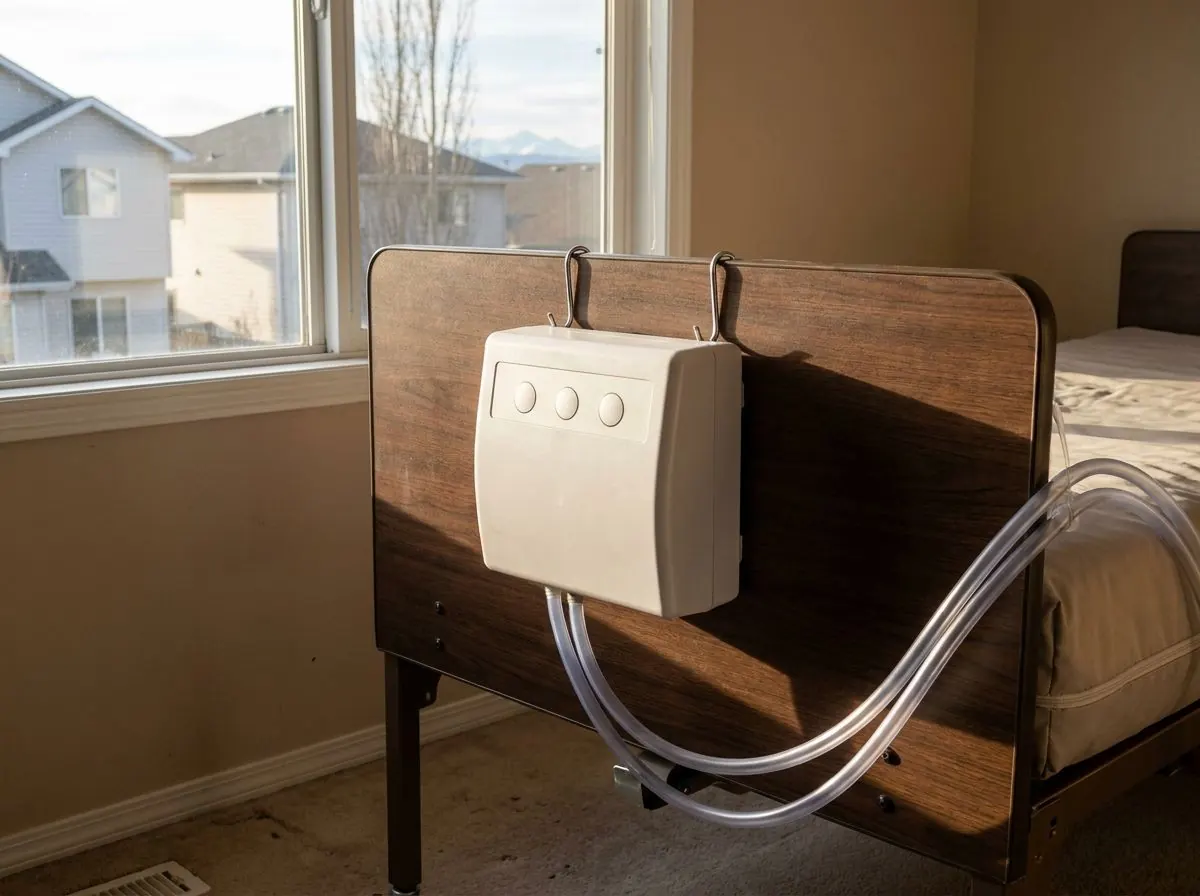
Close view of a compact white air pump hooked over the footboard of a hospital bed, with air hoses running to the mattress.
The pump hangs on the footboard

Before we arrive

  • Confirm the bed: its make, or the size of the mattress it takes now.
  • Keep a wall outlet free for the pump; avoid switched outlets and power bars.
  • Plan the cord and hose route away from walkways and the bed’s moving parts.
  • Know the person’s current weight for the pressure setting.
  • Ask the nurse which sheets and pads to use, since extra layers can work against the surface.
  • Keep the wound care or discharge notes where we can read them at setup.
  • Decide who will be the main caregiver for the walkthrough.

Choosing the right one

Choose the model by three things: the person’s weight, what the clinician has written, and whether the plan calls for low air loss or lateral rotation. For someone within 350 lb who needs alternating pressure alone, the PressureGuard APM or the Med-Aire Essential is the simpler match. If the plan asks for alternating pressure with low air loss and a cycle the clinician can adjust, the Med-Aire Plus is the more flexible system and carries 450 lb. If lateral rotation is specified, look at the APM² or the Easy Air LR. For a heavier person, or a wide bariatric bed, the Easy Air’s 500 lb rating and widths up to 53 inches matter most.

Mattress replacement or overlay? A replacement system takes the place of the bed’s mattress and sits directly on the deck; the Med-Aire systems, the APM² and the Easy Air are full-depth 7 or 8 inch surfaces used this way. An overlay is a thinner pad laid on top of an existing mattress. Overlays are lighter and quicker to fit, but stacking one on a mattress raises the sleeping surface, which changes how high the rails sit relative to the person and how transfers feel. Any air surface changes rail height a little, so the care team should check it once the system is on.

Paying for the rental

AADL handles pressure care differently from beds. Its benefit categories include pressure reduction overlays for Albertans with long-term needs, assessed by an authorizer, but like other AADL benefits it does not reimburse rental charges for temporary or short-term needs, and needs before or after surgery are excluded. A rented alternating pressure system is therefore usually paid privately or through benefits, including while someone waits for an AADL-funded surface to arrive.

Workplace plans generally ask for a physician’s prescription or written recommendation, itemized receipts and sometimes a cost estimate before you rent; we provide the receipts monthly with the system named. WCB requires pre-approval for mattresses and arranges them through its own vendors, so speak to the case manager before renting. Veterans Affairs Canada lists hospital equipment among its special equipment, prescribed by a VAC-approved health professional. One tax caution: pressure mattresses are not named among the medical devices the Excise Tax Act zero-rates, so do not assume the rental is GST-free. GST appears on your invoice as it applies.

Insurance and funding guides

Discharge coming up

Coming home from hospital in the next day or two?

Phone us with the discharge date and what the care team has recommended. We book delivery to arrive before the patient does, whether they are leaving Foothills Medical Centre, Peter Lougheed Centre, Rockyview General Hospital or South Health Campus. Same-day delivery depends on stock and the time you call, so the earlier the better.

Pressure Mattresses: common questions

How long is the alternating cycle?
It depends on the model. The PressureGuard APM runs a fixed 8-minute cycle, the Med-Aire Essential and PressureGuard APM² run 10 minutes, the PressureGuard Easy Air runs 15, and the Med-Aire Plus lets you choose 10, 15, 20 or 25 minutes. We set the system to the clinician’s instruction.
What happens if the power goes out?
Drive says the Med-Aire Plus provides up to 24 hours of power-outage protection, and Savaria says the PressureGuard Easy Air does not lose inflation. The Med-Aire Plus has a power alarm and the APM² has a power failure light. Call us if an outage is long, and follow the care team’s advice on repositioning in the meantime.
The pump is beeping. What should I check?
First check that the pump is plugged in and switched on, and that no hose has come loose or is kinked under the bed. Then look at which light or alarm is showing; we explain each one at setup. If it keeps sounding, phone us.
What is the CPR valve for?
On the Med-Aire Plus and Med-Aire Essential, the CPR valve releases the air quickly so the person lies on the firm deck of the bed if emergency chest compressions are needed. We show the caregiver where it is during setup.
Can a pressure mattress go on our own bed?
These systems are sized for hospital bed decks, for example 80 by 35 inches on the Med-Aire Essential. On a household bed the fit, the edges and the height usually do not work well. Tell us what bed the person has, and we will advise whether a hospital bed should come with it.
Does an alternating pressure mattress heal bedsores?
We cannot promise that, and the manufacturers word it differently. Savaria indicates the Easy Air for treatment of Stage 1 to 4 pressure injuries; Drive describes the Med-Aire Plus for prevention and treatment of pressure ulcers and the Essential for reducing their incidence. Healing depends on the whole care plan.
Can the person sit up on an air mattress?
Yes, with the head of the bed raised. For meals or transfers, use the firm setting on that model: Seat Inflate or Auto-Firm on the Med-Aire Plus, static mode on the Essential, or the timed Auto Firm on the APM² and Easy Air.
Is a mattress replacement better than an overlay?
They do different jobs. A replacement system takes the place of the mattress and gives the full depth of air cells; an overlay sits on top of an existing mattress and raises the sleeping surface. The care team chooses based on the person’s risk and the bed; we supply what they specify.

Rent pressure mattresses in Calgary

Tell us who it is for, the date you need it and the room it goes in. We will confirm the model, the monthly rate and a delivery window.

Call Now Book a Rental