White-glove setup and removal
In-Home Medical Equipment Setup and Removal in Calgary
A hospital bed in a box is no help to anyone. Every rental from us is carried into the house, assembled in the room you choose, tested function by function, and explained to the people who will use it. When the rental is over, we come back, take it apart and remove it, so no one in the family is wrestling a bed frame down the stairs.
This page walks through what happens on both visits: how to get the room ready, how we handle stairs, condos and elevators, what the orientation covers for each kind of equipment, and how to extend, swap or end a rental when needs change.
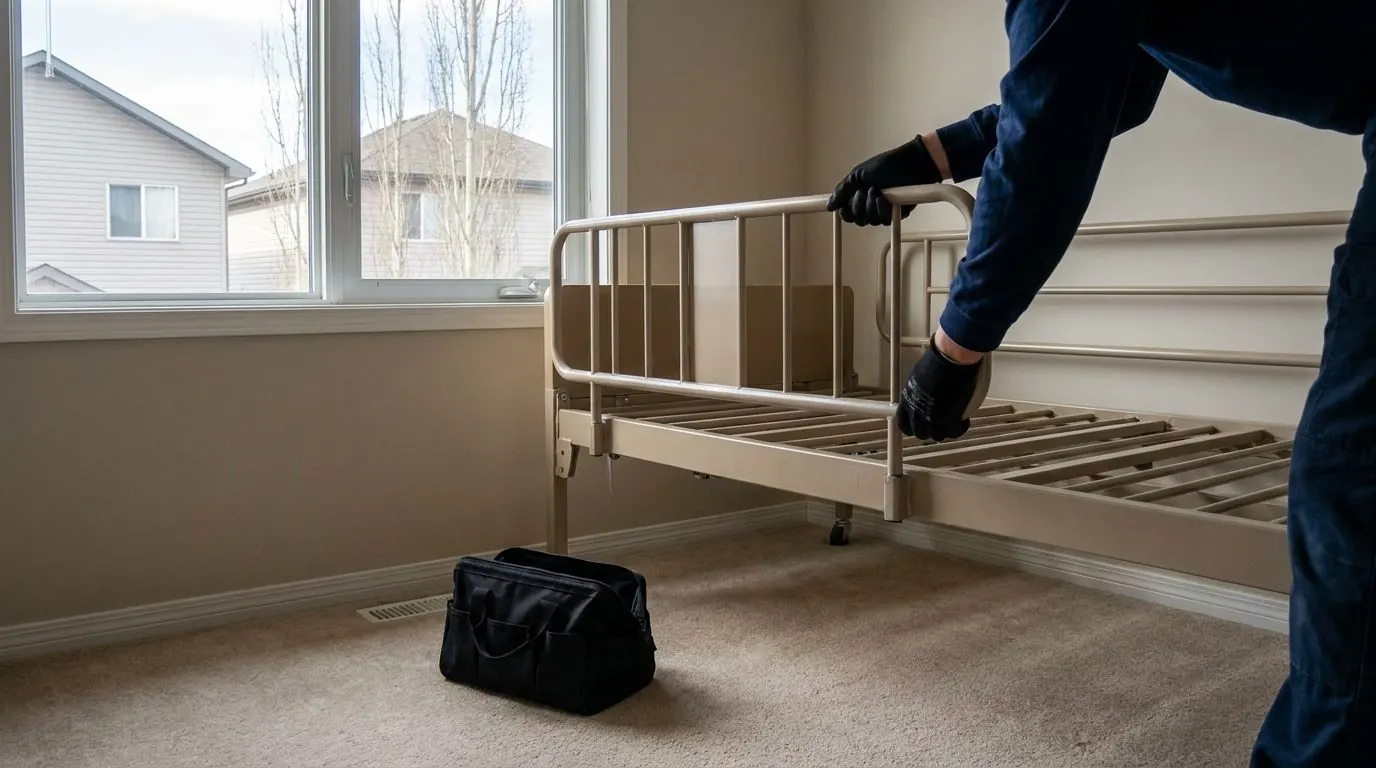
- Assembly
- Done in the room where the equipment will be used
- Testing
- Every motor, brake, alarm and backup checked on site
- Orientation
- For the patient and the caregivers who will be using it
- Removal
- Taken apart, bagged and carried out when you are done
What happens on setup day
- 1
Walk the route
Before anything comes off the truck, we look at the path from the door to the room and at where the equipment will sit, including outlets.
- 2
Carry in and assemble
Beds come in sections, lifts in a base and mast, scooters in pieces. We put them together where they will be used and route cords out of the walkway.
- 3
Test every function
Head, foot and height motors, rails, caster locks, alarms, battery backup and emergency lowering are all run through before we call it ready.
- 4
Show the people using it
We hand the controls to the patient and caregivers and have them try each function while we watch, then answer questions.
Getting the room ready
The best spot for a hospital bed is rarely where the old bed was. Caregivers need to reach at least one side, ideally both, and a patient lift needs clear floor to roll in and open its legs. Invacare’s Reliant 450 lift has a base that opens to 41 inches wide and is 48 inches long, and Drive’s battery-powered lift opens to 41.5 inches, so a bed pushed into a corner can make lift transfers awkward or impossible.
Many families move the bed to the main floor, into a living room or dining room close to a bathroom. That is often the right call, and it is easier to decide before we arrive than to reassemble a bed afterwards. If an OT or PT has visited the home, follow their placement advice.
- Clear a path from the entrance to the room, including rugs that can catch casters
- Move the existing bed or furniture out of the space, or tell us if you need a hand deciding what goes
- Make sure there is a working, grounded outlet close to where a bed, lift chair or pressure mattress pump will sit
- Leave room beside the bed for a caregiver to stand, and room to roll a lift in if one is coming
- For a lift chair, leave space behind it: Pride lists wall clearance of 14 to 21.5 inches across the Radiance sizes
- Keep pets and young children in another room while we carry in and assemble
Stairs, split-levels, condos and elevators
Stairs are part of the job, not an extra. Beds break down into sections, and the pieces are what we carry: Drive ships the Delta Ultra-Light 1000 in two cartons and lists the bed at 169 lb in total, spread across those pieces. Lift chairs are heavy too; Pride lists the Radiance at 156 to 178 lb depending on size. Tell us about tight landings, low ceilings over a stairwell or a spiral staircase, because those change how we plan the carry.
In condos and apartments, the building usually sets the rules. Many downtown and Beltline buildings require the freight elevator to be booked, deliveries to come through a loading dock, or the concierge to be told in advance. Bariatric beds need the most room: Invacare lists the BAR750 at 88 to 96 inches long and 51 inches wide overall once assembled, so we check the elevator and hallway dimensions before delivery day.
What the orientation covers, by equipment
We show you how the equipment works and how to keep it working safely. We do not teach transfer technique, positioning plans or skin care, which belong to the OT, PT or home care nurse. When a clinician has given instructions, we set the equipment up to match them.
- Hospital beds: the hand pendant, raising and lowering the whole bed, side rail use, locking the casters, and the power-outage backup, which is a 9-volt battery in the hand control on the Delta Ultra-Light 1000 and a built-in hand crank on the Invacare 5410IVC
- Pressure mattresses: what the pump’s alarms mean, how to use a firm or static mode for care and repositioning where the model has one, and where the CPR valve is for rapid deflation
- Patient lifts: attaching the sling to the cradle or swivel bar, the emergency stop and emergency lowering, and charging. Drive’s lift will not run while it is plugged in; Invacare’s Reliant 450 uses a removable battery with a spare charging on the wall station
- Sit-to-stand lifts: the controls and emergency stop, with the reminder from Invacare that a stand-up lift moves a person between two surfaces and is not for wheeling them around the house
- Lift chairs: the hand control, how the backrest and footrest move, the battery backup, and how to keep cords clear of the mechanism
- Mobility scooters: charging with the off-board charger, the controls, and how the scooter comes apart for a car; Pride lists the heaviest piece of the Victory 10.2 at 64.5 lb
- Ramps: the handrails, the transitions at top and bottom, and keeping the surface clear of snow and ice through a Calgary winter
Removal at the end of the rental
When you call to end a rental, we book a pickup time that works for the household. You don’t need to take anything apart or pack anything up. Strip the bedding if you can, and leave the rest to us.
Removal is done with the next customer in mind. We take the equipment apart in the room, bag the mattress and any slings or covers before they are carried through the house, and keep returned equipment apart from clean equipment on the truck. Everything then goes through our 10-step cleaning and inspection process before it is rented again. Modular ramps come apart section by section and leave no concrete footings behind, because the EZ-ACCESS PATHWAY 3G stands on multi-positional base feet.
Extending, swapping or ending a rental
Rentals are billed by the month, and recovery rarely follows the plan exactly. To keep equipment longer, phone and extend; there is nothing to return and re-rent. To end the rental, phone and book the pickup.
Swaps are common and we expect them. A patient who started in a hospital bed may move to a lift chair as they get stronger. Someone using a full-body sling lift may be reassessed for a sit-to-stand lift. A family that rented a standard bed may learn that a low bed or a pressure mattress is now needed. We bring the new equipment, set it up, and take the old item away on the same visit where we can. If a clinician has recommended the change, have their recommendation handy when you call.
Before we arrive for setup
- Decide which room the equipment goes in, with the care team’s advice if you have it
- Clear the route and the space, and check for a nearby grounded outlet
- Book any freight elevator or loading dock your building requires
- Have the patient’s weight and any clinician instructions ready to share
- Plan for the main caregiver to be home for the orientation
- Keep a spot free near an outlet for a lift or scooter charger
Questions people ask us
How long does setup take?
Can you move the bed to a different room after it is set up?
Do you teach us how to transfer someone with the lift?
Will you install a ramp at the front steps?
What if something stops working partway through the rental?
Do we need to clean the equipment before you pick it up?
Let us do the heavy lifting
Tell us what is coming, where it is going and how to get there. We will bring it in, set it up, show you how it works and take it away when you are finished.