Palliative and end-of-life support
Palliative Care Equipment for Home in Calgary
When someone has chosen to spend their last weeks or months at home, the equipment around them should make care easier and the room feel like theirs. We give palliative requests priority for delivery and setup of hospital beds, pressure relief mattresses and patient lifts, and we take the time to set them up the way the family and the care team want.
We work alongside the home care and palliative nurses, OTs and physicians who are already involved, not in place of them. They guide the clinical decisions; we make sure the right equipment is in the right spot, working properly, and that the people caring for your loved one know how to use it.
- Priority
- Palliative requests are scheduled ahead of routine bookings
- Equipment
- Comfort-care beds, pressure mattresses, lifts and chairs
- Working with
- Home care, palliative teams, OTs and the family
- Pickup
- When the family is ready, at a time that suits you
Why we prioritise palliative setups
Time matters differently in palliative care. A few days’ wait for a bed can mean a few days of harder care on a low mattress, or a hospital stay that lasts longer than anyone wanted. So when you tell us a request is for palliative care at home, we look for the earliest delivery we can make and move it ahead of routine bookings where we can. When stock and timing allow, that is often the same day.
You don’t need a referral or paperwork to call us. It helps to tell us who is on the care team, because a nurse or OT may already have recommended specific equipment, a bed position in the room, or a pressure surface. We will ask your permission before contacting any of them.
The equipment families most often need
Every situation is different, and the care team’s recommendation comes first. These are the pieces of equipment palliative families ask us for most, and what each one does for day-to-day care.
- A full-electric hospital bed, so the head, foot and overall height can be adjusted from a hand pendant. Raising the bed to a caregiver’s working height makes washing, changing and repositioning easier on everyone’s back, and lowering it again makes getting in and out safer.
- An alternating pressure mattress, where air cells inflate and deflate in turn to shift pressure on the skin of someone who spends most of the day in bed. Drive describes its Med-Aire Plus as combining alternating pressure with low air loss, with cycle times you can select. The nurse will advise whether a pressure surface is needed.
- A low-height bed, when the concern is falls and rails aren’t wanted. The deck on models like these lowers to roughly 9 to 10 inches from the floor.
- A battery-powered patient lift, once transfers from bed to chair or commode can no longer be done safely by hand. Your OT or nurse should show the family how to use the sling before the first transfer.
- A power lift chair, for someone who still wants to sit up in the living room with family but struggles to get out of a chair on their own.
Setting up for comfort, not just function
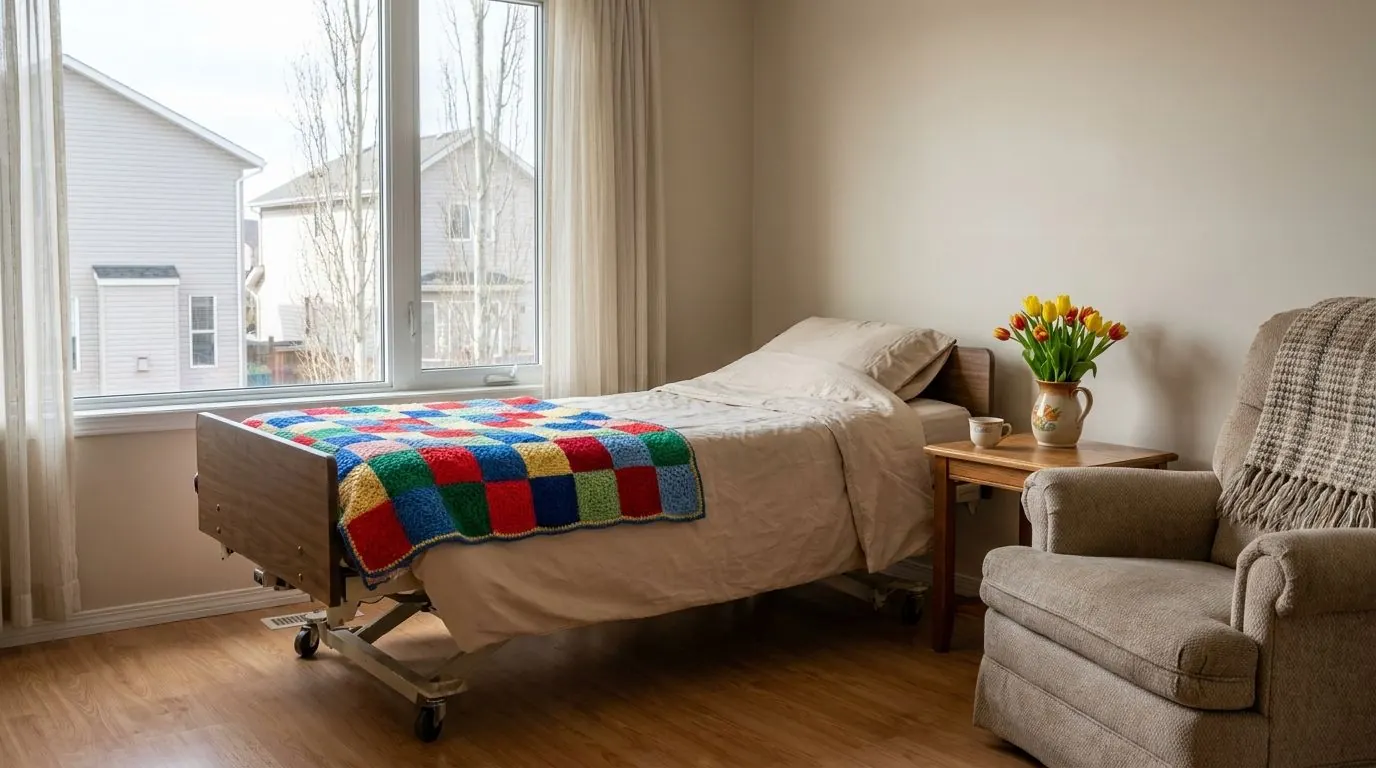
Where the bed goes changes how the last weeks feel. Many families choose a living room or main-floor den rather than an upstairs bedroom: closer to the kitchen and the bathroom, with a window, and in the middle of the household instead of shut away from it. Others want the hospital bed alongside the bed a spouse still sleeps in. We will set it up wherever you want it, and point out anything that would make care harder, such as a bed too close to a wall for a lift to reach.
On a pressure mattress, we show you how to switch to a firmer setting for care tasks where the model has one. Drive’s Med-Aire Plus has an Auto-Firm function, for example, and pumps like it have alarms, so we play them for you in daylight rather than letting the first alarm happen at night. We also show you where the CPR valve is, which lets the mattress deflate quickly, and talk through what the backup does during a power outage. Drive states the Med-Aire Plus gives up to 24 hours of power-outage protection, and each bed has its own method for lowering without power.
- Room for a caregiver on both sides of the bed where the space allows
- The hand pendant within the patient’s reach if they are still using it
- Cords routed away from where visitors will walk and sit
- A clear path for a lift to roll in and around the bed
- Space for a chair beside the bed, for whoever is keeping company
Working alongside home care and the palliative team
Many families caring for someone at home are supported by Alberta Health Services home care or a palliative care team, as well as their own physician. We are independent of all of them. What we can do is fit around them: time a delivery for when the nurse is visiting so they can see the setup, adjust the bed to their instructions, and swap equipment quickly when the nurse or OT says needs have changed.
Needs often change quickly in palliative care. A person who was using a lift chair may need a hospital bed within the week, then a pressure mattress, then a lift. Phone when that happens. We treat a change of equipment for a palliative client with the same priority as the first delivery.
When the time comes to remove the equipment
There is no expectation that you call us on any particular day. When the family is ready, phone and we will arrange a pickup at a time that suits the household. Some families want the bed gone quickly so the room can be put back; others want to leave it in place for a while. Either is fine, and you don’t need to explain.
Our team knows why they are there. They work quietly, take the equipment apart in the room, and carry it out without fuss. If it is easier for a relative or neighbour to let us in while the immediate family is elsewhere, we can arrange that. If a hospital bed is no longer needed but a lift chair or other equipment is still helping someone else in the home, we collect only what you ask us to.
Useful to have when you call
- That the request is for palliative care at home, so we can prioritise it
- The equipment the nurse, OT or palliative team has recommended, if any
- The person’s approximate weight and whether they are in bed most of the day
- Which room you would like the bed in, and how many steps lead to it
- When the person is coming home, or whether they are already home
- A contact on the care team, if you are happy for us to speak with them
Questions people ask us
How quickly can a hospital bed be set up for palliative care?
Can the hospital bed go in the living room?
Do we need a pressure mattress as well as the bed?
Can we rent the bed while waiting for AADL-funded equipment?
What happens with the rental after our loved one dies?
Will the delivery team know the situation?
Call us about care at home
Tell us what the care team has recommended and when it is needed. We will make it a priority and set it up with care.