Cleaning and safety standards
How We Clean and Check Rental Medical Equipment in Calgary
Rental equipment has been in someone else’s home before it comes to yours. That is a fair thing to worry about, especially when the person using it is frail, recovering from surgery or has fragile skin. So every bed, mattress, lift, lift chair, scooter and ramp we rent goes through the same 10-step process between customers, and nothing skips a step because it looks clean.
Between every rental, each item is cleaned and then disinfected with a Health Canada DIN-registered disinfectant, following the manufacturer’s instructions and the Spaulding non-critical device reprocessing principles set out in Alberta’s Reusable & Single-Use Medical Devices Standards. The rest of this page explains what that means in plain words, and exactly what the 10 steps are.
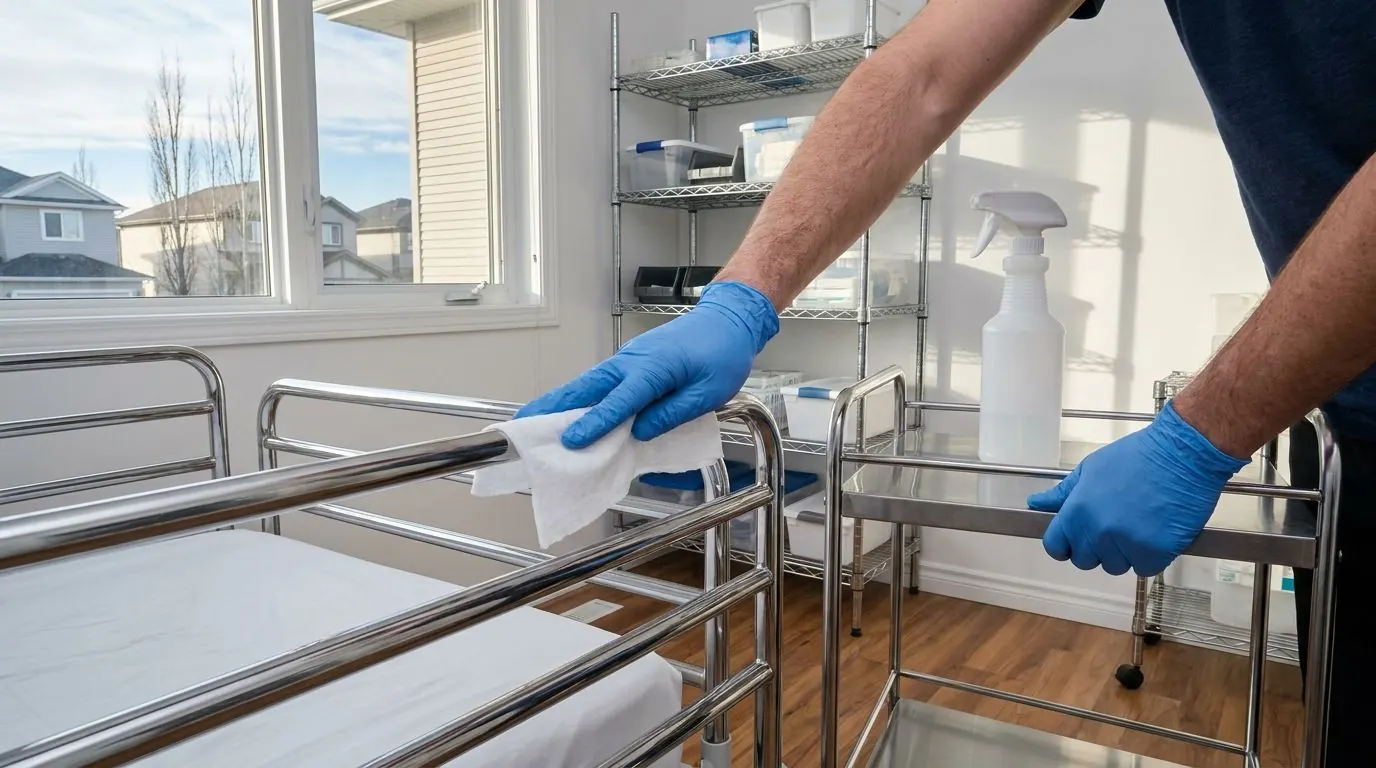
- Every item
- The same 10 steps between every rental
- Disinfectant
- Health Canada DIN-registered, used at its label contact time
- Principles
- Provincial IPC principles for non-critical reusable equipment
- Before it leaves
- Function, safety and battery tested, then bagged and tagged
Our 10-step cleaning and inspection protocol
- 1
Pre-clean inspection
Returned equipment is logged as used and looked over before cleaning starts. Damage, worn parts and any fault the last customer reported are noted so they are fixed or the item is pulled from service.
- 2
Remove soft goods
Mattress covers, slings, pads, straps and bags come off. Each is laundered or cleaned as its maker’s label directs, and anything worn, stained or past its service life is retired rather than reused.
- 3
Clean
Every surface is cleaned with detergent and wiping to remove visible soil, paying attention to hand controls, rails, grab handles, casters and seams. Disinfectant cannot work properly through dirt, so cleaning always comes first.
- 4
Disinfect
Surfaces are disinfected with a Health Canada DIN-registered disinfectant and left wet for the full contact time on its label, using a product and method the equipment manufacturer allows.
- 5
Rinse and dry
Where the disinfectant label calls for a rinse, surfaces are rinsed. Everything is then left to dry completely, since damp seams and air cells are where problems start. Pumps and electrical parts are never soaked.
- 6
Mattress and cover integrity check
Mattress covers are unzipped and inspected for tears, worn seams and any sign fluid has got through. Air mattresses are inflated and checked for leaks. A mattress with a failed cover does not go out again.
- 7
Function and safety test
Every motor and control is run through its full range. We check side rails, caster locks, lift booms, emergency stops and emergency lowering, pump alarms and CPR valves, ramp connections and scooter brakes.
- 8
Charge and battery test
Lift, scooter and lift chair batteries are fully charged and checked to hold a charge. Low-battery alarms and backup batteries, such as a bed’s hand-control battery, are tested and replaced if weak.
- 9
Bag, seal and tag
Mattresses and slings are sealed in clean packaging. Each item is tagged with the date it was cleaned and checked, so you and we can both see it was done.
- 10
Clean storage, apart from returns
Finished equipment is stored in a clean area kept separate from equipment waiting to be cleaned, and it travels separately on the truck, so used and clean items never mix.
What “non-critical” equipment means
Health care sorts reusable equipment into three groups, often called the Spaulding classification, based on what the equipment touches. The group decides how thoroughly it has to be processed before the next person uses it.
Home medical rental equipment falls into the lowest-risk group. Beds, lifts, lift chairs, scooters and ramps touch a person’s intact skin, or don’t touch them directly at all. For this group, the recognised approach is to clean each item and then disinfect it between users with an appropriate disinfectant. That is the standard we work to.
- Critical: equipment that enters sterile parts of the body, such as surgical instruments. We don’t rent anything in this group.
- Semi-critical: equipment that touches mucous membranes or broken skin. We don’t rent anything in this group either.
- Non-critical: equipment that touches intact skin or doesn’t touch the person at all. Every item we rent is in this group.
Why cleaning and disinfecting are separate steps
People often use “cleaning” to mean both. They are different jobs. Cleaning removes dirt, body oils and residue. Disinfecting kills germs on the surface that remains. A disinfectant sprayed over a sticky bed rail or a grimy hand pendant is working through a layer of soil, which is why the provincial principles put cleaning first and why our process does too.
Contact time matters just as much. Every disinfectant with a Health Canada DIN has a label that says how long the surface must stay wet for the product to do what it claims. Spraying and immediately wiping dry doesn’t meet that. We use the label time, every time, and choose products and methods the equipment manufacturer permits, because some cleaners damage mattress covers, vinyl upholstery and plastic controls. Drive’s instructions for one of its alternating pressure systems, for example, say the pump and mattress can be cleaned with disinfectant solution but must not be immersed, and should be fully air-dried.
Mattresses, covers and slings get extra attention
The parts of rental equipment that touch a person most closely are the mattress surface and the lift sling, so they get the closest look. A mattress cover can look perfect from the outside and still have a split seam or a pinhole that let fluid into the foam or the air cells beneath. That is why step 6 opens the cover and inspects what is underneath, rather than judging by the surface alone.
Slings and soft goods are fabric, which is handled differently from a steel bed frame, so they come off the equipment at step 2 and are cleaned as their maker’s label directs. Worn webbing, frayed straps, damaged stitching or a faded or missing label mean the sling is retired. Clean mattresses and slings are then sealed in packaging at step 9, so they stay clean between our storage area and your home. You open the package; we don’t.
Safety checks are part of cleanliness
A spotless bed with a failing hand-control battery isn’t ready to rent. The function and battery tests at steps 7 and 8 exist because the moments equipment matters most are often the worst times to find a fault: a power outage overnight, a transfer halfway done, a pressure mattress alarm at three in the morning.
So each item is run through the checks its maker builds in. Beds are raised and lowered through their full range, and backup systems are tested: on the Drive Delta Ultra-Light 1000, a 9-volt battery in the hand control is meant to lower the head and foot sections nine times without power. Patient lifts have their emergency stop and emergency lowering tried, and their low-battery warning confirmed. Pressure mattress pumps are run long enough to check their alarms. Anything that fails a check is repaired and re-tested, or taken out of service.
What you can do during the rental
Our process covers the equipment between customers. While it is in your home, ordinary cleaning keeps it pleasant and safe to use. Ask the home care nurse what they recommend for the patient’s situation, particularly where there is an infection or a wound. For day-to-day care, wipe hand controls, rails and armrests regularly, keep liquids away from pumps and controls, and don’t soak or pour cleaner onto anything electrical.
If the equipment is damaged or soiled in a way that ordinary cleaning won’t handle, such as a torn mattress cover, phone us. It is much better to swap a cover or mattress early than to keep using a surface that can no longer be cleaned properly.
Questions people ask us
Is rental equipment sanitary for someone with fragile skin or low immunity?
Is the equipment sterile?
Do you hold an Alberta Health Services cleaning certification?
Do you reuse mattress covers and slings?
How do I know the equipment I received was cleaned?
What happens to equipment after you pick it up from my home?
Questions about cleaning? Ask us directly.
Call and we will explain how a particular bed, mattress or lift is cleaned and checked before it comes to your home.