Skip to content
Discharge-day delivery: (825) 445-5851

Patient Transfer Lifts & Power Mobility

Electric Hoyer Lift Rental in Calgary

Most people call it a Hoyer lift. Hoyer is a brand name, but it has become the everyday word for any floor lift that raises a person in a fabric sling and moves them between bed, wheelchair, commode or recliner. The two lifts we rent are made by Invacare and Drive Medical, and both are battery-powered, so the caregiver presses a button instead of pumping a hydraulic handle.

We deliver the lift, assemble it in the room where transfers will happen, check it against your bed and chair, and show whoever will be doing the lifting how it works before we leave. Your occupational therapist or physiotherapist sets the transfer plan: which sling, how many caregivers, and which moves are safe. Our job is to make sure the equipment in your home matches that plan.

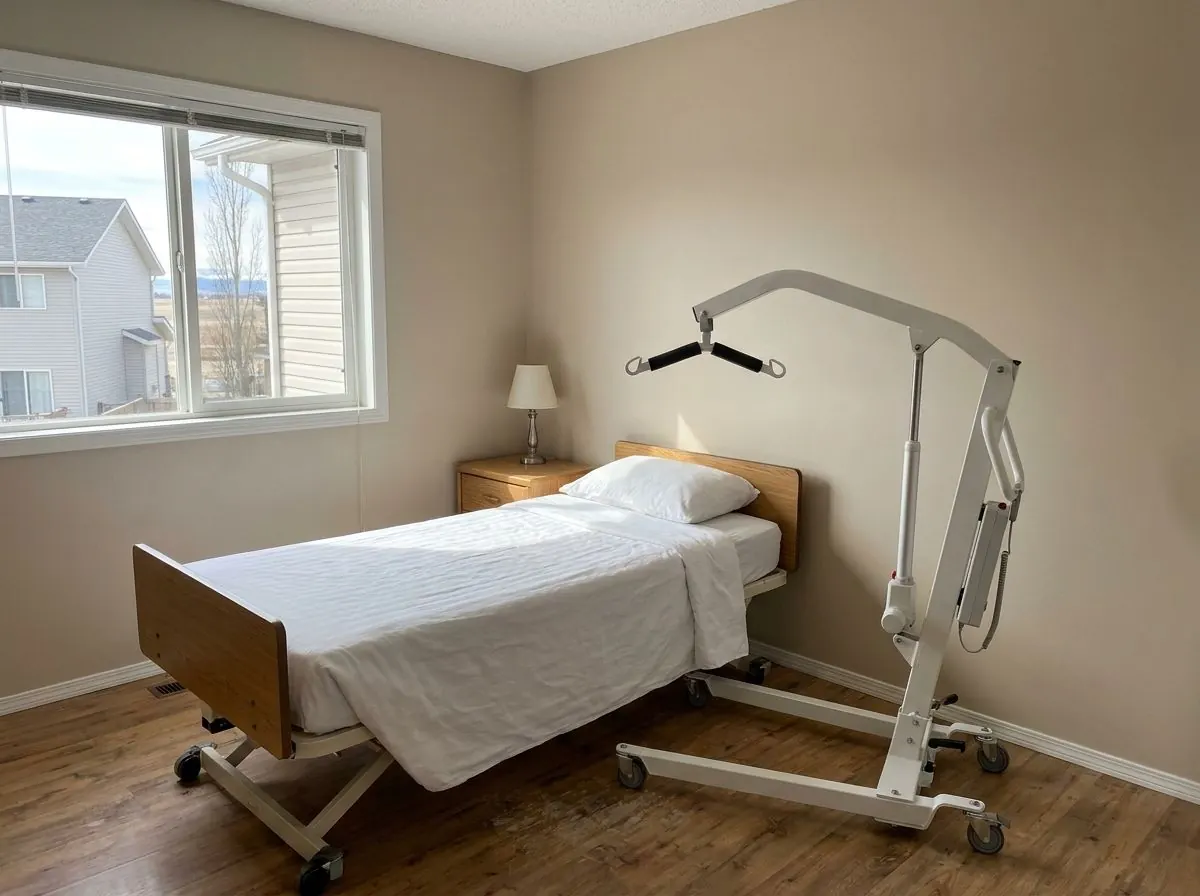
A white battery-powered patient floor lift with a tall mast and curved boom standing beside a made hospital bed in a home bedroom.
A battery-powered floor lift beside a hospital bed

Monthly rental

$325–$450/mo

Models we rent

  • Invacare Reliant 450 Battery-Powered Lift (RPL450-1)
  • Drive Medical Battery-Powered Patient Lift (13240)
  • Delivered and set up in your home
  • Cleaned and safety-checked before every rental
  • Itemized receipts for benefits claims

Who this rental is for, and when it is needed

A sling lift is for someone who cannot safely stand or take weight through their legs for a transfer, or who is too heavy or too unpredictable to move by hand. That includes people coming home after a spinal cord injury or a stroke, people with advanced MS, ALS or Parkinson’s, and people in the last weeks of a palliative illness who still want to sit up in a chair or use the commode. It also protects the caregiver. A spouse in their seventies who has been told “no more manual lifts” by the home care nurse needs the machine to do the lifting, not more effort from their own back.

The trigger is usually a discharge. A patient at Foothills Medical Centre, Rockyview General Hospital, Peter Lougheed Centre or South Health Campus has been transferring with a ceiling or floor lift on the unit, and the team says the same method has to continue at home. Sometimes there is a week of notice. Often there are two days. A rental covers the gap while you wait for a long-term decision, or it covers the whole need when the time at home is expected to be short.

Situations we set this up for

  • Hospital team says transfers must be done with a mechanical lift
  • Coming home after a spinal cord injury, stroke or long ICU stay
  • Palliative care at home, with bed-to-chair or bed-to-commode moves
  • A caregiver has hurt their back doing manual transfers
  • Getting someone up off the floor after a fall, where the care team has shown you how
  • Waiting on a funded lift and needing one now

Models and specifications

Figures below are the manufacturer's published specifications. We confirm the exact unit and its ratings with you before delivery.

Invacare

Reliant 450 Battery-Powered Lift with Low Base Model RPL450-1

The Reliant 450’s 24-volt battery sits on the mast and lifts off with a quick release, then drops into a wall-mounted charging station. That means the lift itself never has to be parked near an outlet, and a flat battery is a swap rather than a wait. An audible alarm warns you when the battery is getting low. Invacare’s published figures for lifts per charge vary with the load and how high you raise the boom; in practice you can count on well over 100 lifts between charges.

The base legs open and close with a padded shifter handle rather than a motor. Open, they spread to 41 inches so the lift can straddle a wheelchair or commode; closed, they narrow to 26.5 inches to roll through a bedroom doorway. The swivel bar turns a full 360 degrees and has six hook-up points. It takes Invacare’s chain-free slings and older styles with chains or straps. Invacare states that only Invacare slings and accessories should be used on its lifts, and we hold to that.

Safety features are the ones you want to know about before the first transfer. There is an emergency OFF button on the battery box. If power is lost entirely, the boom can be lowered by hand using the emergency release, so nobody is left hanging in a sling. While lowering, an anti-entrapment feature stops the boom if it meets resistance, and covers guard the pinch points on moving parts.

Weight capacity
450 lb (204 kg)
Lift range at sling hook-up
24" to 74" (61 to 188 cm)
Base height
4.5"
Base width
41" open / 26.5" closed
Base length
48"
Casters
3" front, 5" rear; rear casters lock
Lift weight
106 lb out of the carton
Battery
Removable 24 V sealed, charges in a wall station
Hook-up
Six-point swivel bar, 360° rotation

Drive Medical

Battery-Powered Patient Lift Model 13240

Drive’s lift uses a Linak motor and a jumbo actuator, and Drive gives its boom height as 27.5 to 76 inches. Invacare measures the Reliant 450 at the sling hook-up instead, so the two ranges are not a like-for-like comparison; if reach at the top matters, because the person is tall or the bed is raised high for nursing care, we check it on the actual lift. The cradle takes slings with either four or six attachment points, which gives the OT more sling styles to choose from.

Charging is the one habit to learn. The battery stays on the lift and charges from an ordinary wall outlet through a cord. The lift will not operate while it is plugged in. That is a safety design, but it catches families out: someone plugs it in overnight beside the bed, forgets to unplug in the morning, and thinks the lift has failed. Unplug first, then lift. An audible warning sounds once the charge falls below 50 percent, which is your cue to charge at the next quiet moment rather than mid-transfer.

For a power failure or a flat battery with someone in the sling, the red emergency button switches the actuator to manual mode, and a quick-release lever lets the caregiver lower the person safely. We have you practise this at setup with an empty sling, so the first time you use it is not an emergency.

Weight capacity
450 lb (204 kg)
Boom height
27.5" to 76" (70 to 193 cm)
Overall width
25" closed / 41.5" open
Base clearance
2"
Rear casters
5"
Cradle
4/6-point
Lift weight
108 lb
Charging
Plugs into the wall on the lift; will not run while plugged in

What makes it work at home

Push-button raising and lowering

A hand control raises and lowers the boom smoothly. The caregiver’s hands stay free to steady the person and guide the sling, instead of pumping a hydraulic handle.

Manual lowering if the power fails

Both lifts have an emergency lowering method that works with no battery at all. We show you where it is and have you try it before we leave.

Legs that open around chairs

The base spreads wide enough to wrap around a wheelchair or commode, then closes for doorways. Open the legs for stability during the lift itself.

Low-battery warnings

Each lift sounds an alert as charge runs down, so a routine evening charge keeps you from ever starting a transfer on an empty battery.

Slings matched to the lift

Invacare lists compatible slings from full-body styles to commode and toileting slings. The OT or PT chooses the type and size; we check that it suits the lift you rent.

Caregiver training at setup

We walk through the controls, charging, leg spreading, caster locks and emergency lowering with the people who will be doing transfers.

Delivery and setup

Before we load the truck we ask four things: the person’s weight, the sling the care team has recommended, the kind of bed they will be using, and what they will transfer to. The answers decide which lift comes. On arrival we assemble the mast and boom, fit a charged battery, and roll the lift through the actual route: bedside, to the chair, to the bathroom door if a commode transfer is planned. If the legs will not slide under the bed or the boom will not reach, we find out then, not at 10 p.m. on the first night.

Then we train. We show how to spread and close the legs, lock and release the rear casters, raise and lower the boom, attach sling loops, charge the battery, and lower someone by hand in a power failure. We run an empty-sling practice with the caregivers. We do not decide how your family member should be transferred: if home care or the hospital therapist has given you a plan, keep it next to the lift and follow it. If nobody has, ask for an OT home visit before the first transfer.

How in-home setup and pickup work
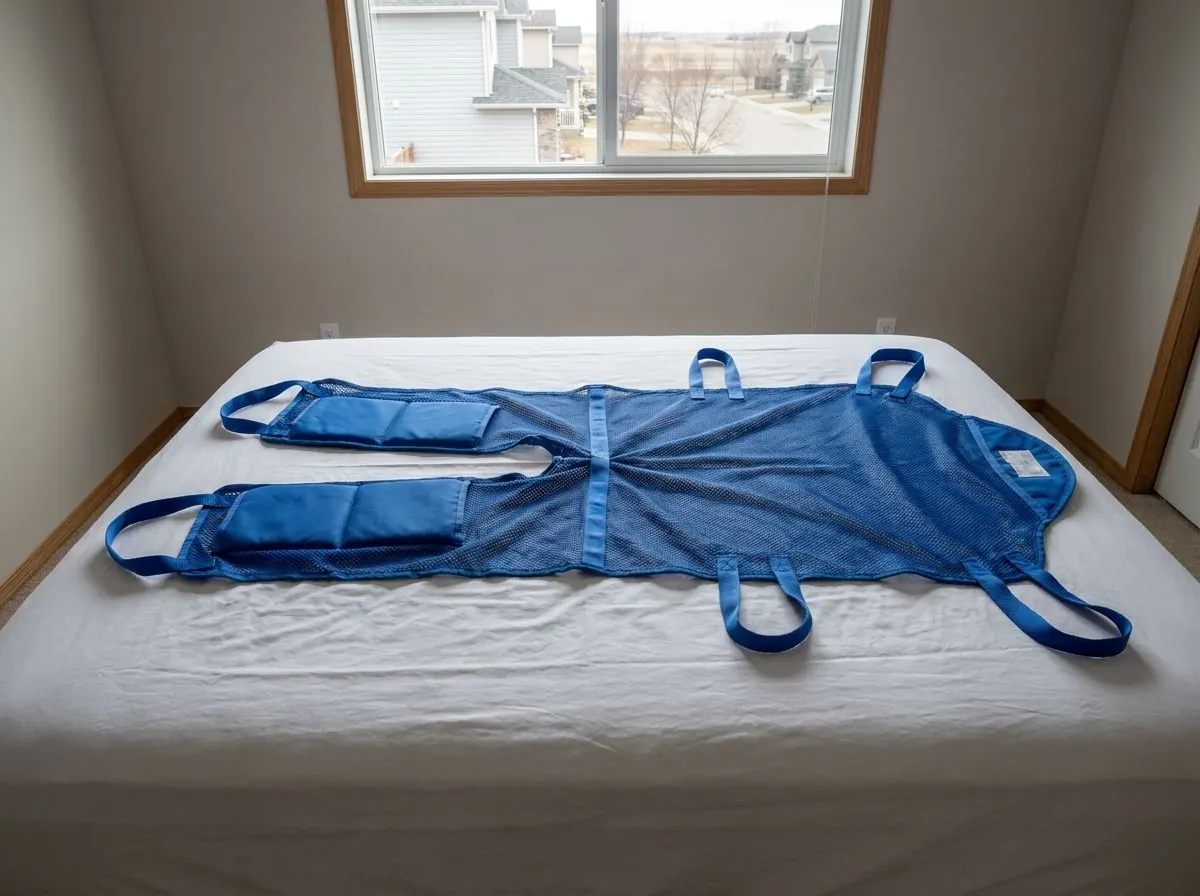
A blue mesh full-body patient lift sling with fabric loop straps laid flat across a made bed.
A full-body sling laid out ready for a transfer

Before we arrive

  • Measure the gap under the bed frame at its lowest point. Platform beds and divans with no gap will not work with a floor lift.
  • Clear a route about four feet wide between bed and chair. Move throw rugs, cords and footstools out of it.
  • Find an outlet near where the lift will be parked (Drive) or a wall spot for the charging station (Invacare).
  • Have the sling recommendation from the OT or PT ready, including size, if you have one.
  • Know the person’s current weight, and the weight of any hospital bed they are using.
  • Arrange for every caregiver who will do transfers to be home at delivery.
  • If the transfer goes to a bathroom, measure the door width and check that the commode or toilet has room for open legs around it.

Choosing the right one

Both lifts carry 450 lb, so capacity rarely decides it. The practical differences are height, charging and sling style. The makers measure height differently (Drive gives a boom height of 27.5 to 76 inches, Invacare a sling hook-up range of 24 to 74 inches), so if the person is tall, the bed is set high, or transfers go to a low chair or the floor, tell us and we check the reach on the actual lift. For households where several people share caregiving, the Invacare’s removable battery is easier: nobody can forget to unplug it, and charging happens on the wall.

Sling compatibility matters more than most people expect. If the hospital or home care has already fitted an Invacare sling, choose the Reliant 450, because Invacare says its lifts should be used only with Invacare slings. If the OT wants a four-point sling, the Drive cradle accepts one. If the person can bear some weight and help with a standing transfer, ask the therapist whether a sit-to-stand lift would give them more independence. That is a different machine with a different sling.

Paying for the rental

Alberta Aids to Daily Living funds patient lifters and slings for Albertans with long-term needs, and registered nurses, OTs and PTs can authorize them. AADL does not reimburse rental charges for temporary or short-term use, including recovery after surgery, and lifters it supplies usually come from its recycled inventory. Many families rent while an AADL request is being processed. If the person has a WCB Alberta claim, equipment must be pre-approved and an OT assessment is required, so speak to the case manager before you rent. We can provide a written quote.

Workplace and private health plans vary. Most ask for a physician’s prescription or written recommendation and itemized receipts, and some want a cost estimate before you rent. Veterans may be able to claim transfer and lift devices through VAC’s special equipment program with a prescription. We give itemized receipts showing the lift model and rental period.

Insurance and funding guides

Discharge coming up

Coming home from hospital in the next day or two?

Phone us with the discharge date and what the care team has recommended. We book delivery to arrive before the patient does, whether they are leaving Foothills Medical Centre, Peter Lougheed Centre, Rockyview General Hospital or South Health Campus. Same-day delivery depends on stock and the time you call, so the earlier the better.

Hoyer Lifts: common questions

Is a Hoyer lift the same thing as a patient lift?
In everyday use, yes. Hoyer is a brand name that people now use for any floor lift with a sling, the way people say Kleenex for any tissue. The lifts we rent are the Invacare Reliant 450 and the Drive Battery-Powered Patient Lift. They do the same job: lifting a person in a sling from one surface to another.
Do you supply the sling, and which one do I need?
Tell us what the care team recommended and we will check that it is compatible with the lift you rent. The type (full-body, commode or toileting) and the size should come from the OT, PT or home care nurse who assessed the person. If you already have an Invacare sling from hospital or home care, tell us, so we send the Reliant 450.
Will the lift fit under our bed?
Measure the space under the bed frame. Invacare gives the Reliant 450 base a height of 4.5 inches, so the legs need a gap at least that tall. Drive lists base clearance of 2 inches on its sheet. We check the actual unit against your measurement before delivery. Platform beds and storage beds with drawers often have no usable gap at all.
Does a lift transfer need two people?
That depends on the person and is decided by the care team, not by us. Many teams recommend two caregivers for sling transfers, especially at first or when the person is anxious, heavy or has spasms. If you have been given a one- or two-person plan, follow it every time.
What happens if the battery dies with someone in the sling?
Both lifts can be lowered without power. The Reliant 450 has a manual emergency release; the Drive 13240 has a red emergency button that switches to manual mode and a quick-release lowering lever. We show you both at setup and have you practise with an empty sling.
Can we use the lift on carpet?
Yes, but it takes more effort to push, and small casters can catch on thick pile and rug edges. Keep transfers short, clear loose rugs away, and move slowly. On hardwood, tile or vinyl it rolls easily, so be deliberate about locking the rear casters when the plan calls for it.
Can the lift get someone up off the floor after a fall?
Invacare lists floors, along with beds, chairs, commodes and tubs, among the places the Reliant 450’s lift range reaches. Whether it is safe to lift a particular person off the floor, and how, is something to ask the OT or nurse first. If there is any chance of injury from the fall, call for medical help before moving them.

Rent hoyer lifts in Calgary

Tell us who it is for, the date you need it and the room it goes in. We will confirm the model, the monthly rate and a delivery window.

Call Now Book a Rental